Putting together an X-shaped stand and bench
inMusic Brands Support · YouTube
The maker of Alesis keyboards shows how to put together a typical X-shaped stand and bench and set up the accessories that come with them. Most brands work the same way.
A keyboard is a friendly instrument to start on: press a key and you get a clear note straight away. These free lessons show you how to set it up safely, how to sit and hold your hands, how to find your way around the keys and how to read music for both hands, one small step at a time.
Need an instrument? Students who can't afford one can apply to us. Free tutoring is something we're planning for the future. Until then, these free lessons are the place to start.
Put the stand, seat and cables together before you play a note.
inMusic Brands Support · YouTube
The maker of Alesis keyboards shows how to put together a typical X-shaped stand and bench and set up the accessories that come with them. Most brands work the same way.
YamahaCanadaMusic · YouTube
Yamaha's own quick-start video for its portable keyboards. It shows how to set the keyboard up and connect it to the power and to a foot pedal.
National Institutes of Health (NIDCD)
A U.S. government health page on how loud sound harms hearing, worth reading before you plug in headphones.
Set the stand and seat so your elbows are about level with the keys.
Hoffman Academy · YouTube
A friendly teacher who makes lessons for children goes through where to sit, how high, and how to hold your arms and hands. About 14 minutes.
Yamaha Musical Instrument Guide
Pictures from an instrument maker's guide showing where to sit, how to tell if the seat is too low, and a relaxed, rounded hand.
Pianist Magazine · YouTube
A piano teacher shows the right seating position at the keys.
Pianist Academy with Charles Szczepanek · YouTube
A piano teacher's beginner lesson on how to tell if you are sitting too high or too low. About 6 minutes.
Curved fingers and a loose, level wrist are the habits that make everything later easier.
Pianist Magazine · YouTube
A piano teacher shows how to shape your hands and keep the wrist and arm in line.
Pianote · YouTube
A short demonstration of good hand posture from a piano teacher.
Hoffman Academy · YouTube
Keyboard music tells you which finger to use with a number. This lesson teaches them with a quick quiz and a mystery-song game. About 7 minutes.
Pianote · YouTube
A short lesson on what the sustain pedal does and how to work it with your foot. Leave this until you can play a few tunes.
Learn each hand on its own first. Put them together only when both parts feel easy.
Hoffman Academy · YouTube
A first piano lesson made for kids: find the groups of two and three black keys, then play Hot Cross Buns. About 13 minutes.
Hoffman Academy · YouTube
C is the white key just to the left of each pair of black keys; middle C is the one nearest the middle of your keyboard. Then a short tune to play on it.
Bill Hilton
A long-running teacher channel's beginner series. Lesson 1 finds and names the keys, lesson 2 starts reading music and lesson 4 adds the left hand; later lessons build up to pieces with both hands. There are 21 numbered lessons, then a few extra videos aimed at adults.
Bill Hilton · YouTube
Lesson 5 of the course above, where you learn a short practice piece. Watch lessons 1 to 4 first, because lesson 4 adds the left hand. About 15 minutes.
Keyboard music uses two staves joined together, called the grand staff: the treble clef on top, usually for the right hand, and the bass clef below for the left.
Hoffman Academy · YouTube
Explains lines and spaces, high and low, and the guide notes Middle C, Treble G and Bass F. About 12 minutes.
Bill Hilton · YouTube
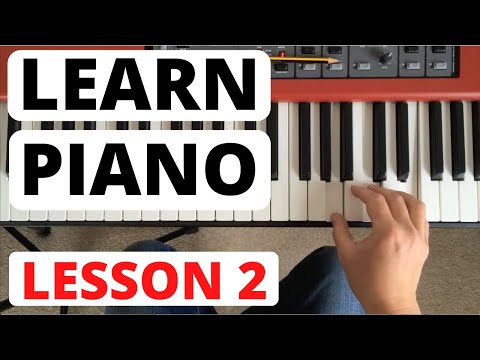
Lesson 2 of the free Bill Hilton beginner course. It starts with the five lines of the staff and the treble clef, which usually shows what the right hand plays, then the short extra lines (ledger lines) for notes above and below the staff. A free PDF of notes and exercises goes with it. Watch lesson 1, on the names of the keys, first.
Gracie Terzian · YouTube
A short lesson with an easy trick for reading the bottom staff, which your left hand usually plays.
musictheory.net
Short animated lessons that work on a phone and need no account. Start with the first few.
A digital keyboard never needs tuning. It mostly needs to be kept clean, dry, cool and steady.
Yamaha
Pages 5 to 7 of this Yamaha manual list the rules for power, water, cleaning and moving, and when to take it for repair. Your own keyboard's manual has a similar list.
Kawai
A keyboard maker's short guide: a barely damp cloth for the keys, no alcohol or harsh cleaners, and no sun, heaters or air vents.
G Major Music Theory
Given away free by the arranger, a former music theory teacher, on his own site. Some of the very first pieces have no staff lines at all, and each piece has a printable page and a recording.
IMSLP
Public domain (this edition published 1919). A classic step-by-step beginner method; choose the G. Schirmer edition, which has English text. Some early exercises have an extra part for a teacher or parent to play along.
Open Music Theory
Openly licensed (Creative Commons BY-SA). Written for college students, but this chapter is a clear reference with pictures linking each key to its note.
Yamaha Global · YouTube
A short demonstration on a Yamaha portable keyboard. Most keyboards have a similar button; check your manual.
musictheory.net
A quick game for learning to name notes on the staff. Try it in treble clef, then bass clef.
Yamaha Hub
A keyboard player's advice: practice slowly, in small sections, and one hand at a time before putting them together.
The small things that wear out or keep the instrument working. You don't need all of them on day one, and any music shop can help you pick the right size.
Let you practice at any hour without disturbing anyone. A wired pair lasts for years if you unplug it by the plug, not the cord.
Many keyboards have a large 1/4-inch headphone socket, so ordinary phone headphones need this small adapter. Keep a spare; they are easy to lose.
A foot switch that lets notes ring on, used in most piano music after the first few months. A universal one with a polarity switch works with almost any keyboard and lasts for years.
A common choice: M-Audio SP-2
Holds the keyboard steady at the right height. Lock the height pin firmly, and lift the keyboard off before you change the height.
A common choice: On-Stage KS7190 Single-X Keyboard Stand
Lets you set the seat so your elbows are about level with the keys. A firm chair works too; if it is too low, sit on a folded blanket or towel.
A common choice: On-Stage KT7800 Three-Position X-Style Keyboard Bench
Keeps dust, crumbs and pet hair out of the keys between practices. Count your keys first, usually 61 or 88, and buy that size.
For wiping the keys and case, dry or barely damp. Wash and reuse them for years.
Pairing students with volunteer tutors is something we're planning for the future. Until then, the free lessons on this page are what we'd like you to learn from. They belong to the people who made them; we link to them because they're free and they teach well.
Print the care card One page to keep with your keyboard: the "Before you start" list and a code that leads back here.
We don't control these sites, so things can move or change. Links last checked November 15, 2026. Found a broken one? Tell us at [email protected].
Other instruments: ViolinViolaCelloAcoustic GuitarElectric GuitarBass GuitarUkuleleFluteClarinetAlto SaxophoneRecorderTromboneDrum Kit